
PSTN Replacement Options Ranked: SIP vs Hosted vs FTTP
The countdown to January 31, 2027, is no longer a distant warning; it is an active operational deadline. As BT Openreach prepares to permanently retire the Public Switched Telephone Network (PSTN) and ISDN, every UK business faces a critical crossroads. The question is no longer whether to switch, but which digital path will protect your operations, reduce your overheads, and future-proof your growth.
CTA: Get Your Free 2027 Readiness Audit → https://talkingvoip.co.uk/contact/
The Digital Shift: Understanding Your 2027 Options
For over a century, the PSTN was the bedrock of British business. It was reliable and universal, but it was also analogue. In a world of high-speed data, AI integrations, and hybrid working, the old copper network has become a bottleneck to national productivity. The move to “All-IP” is a mandatory upgrade that replaces physical circuits with virtual streams.
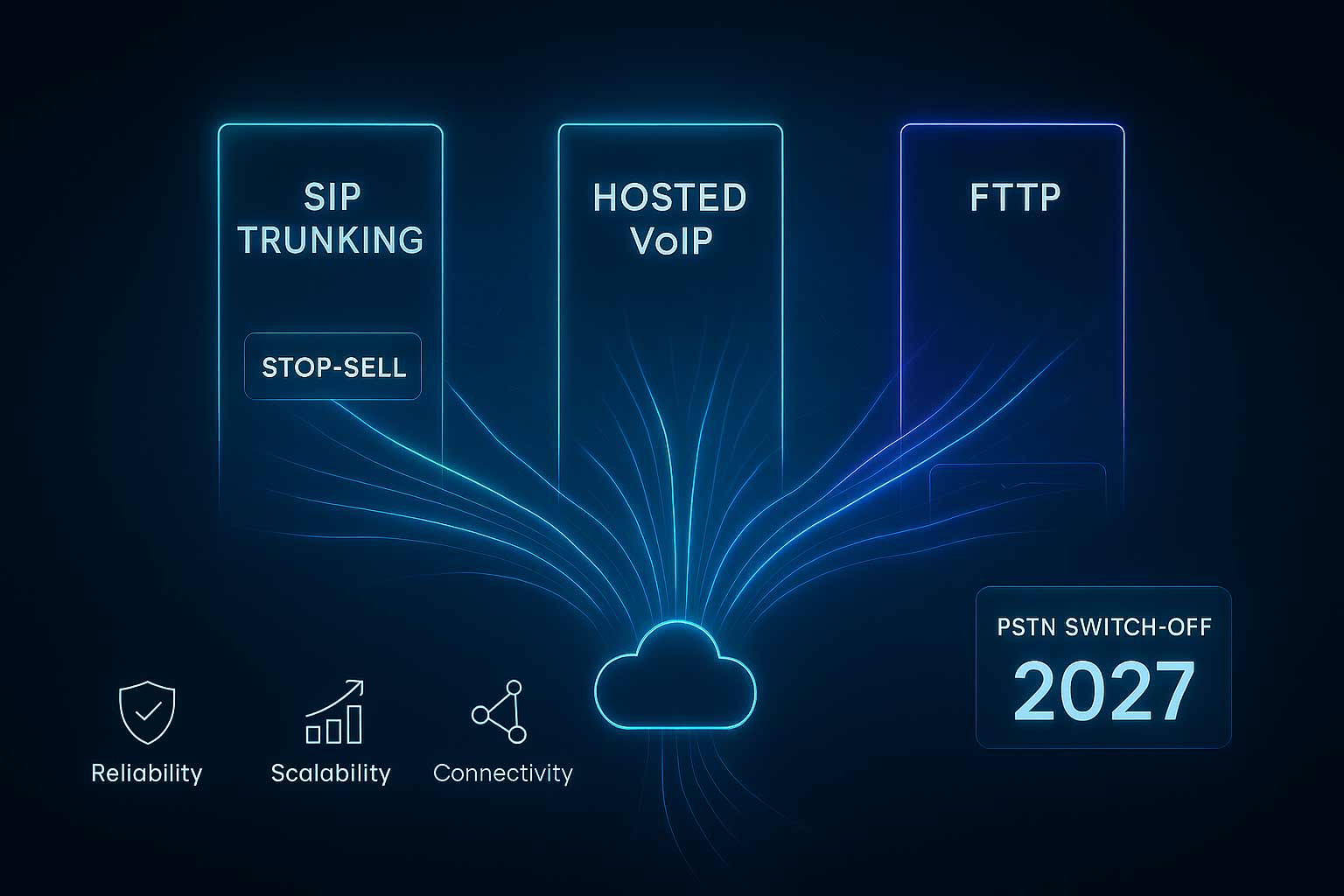
However, many business owners are overwhelmed by the jargon. Is a “Hosted” system the same as “VoIP”? Do you need SIP trunks if you already have fibre? Below, we rank the three most viable replacement strategies based on Scalability, Cost-Efficiency, and Technical Complexity.
The PSTN Replacement Comparison Matrix
| Option | Overall Rank | Scalability | Cost-Efficiency | Complexity | Best For |
|---|---|---|---|---|---|
| Hosted VoIP | ⭐⭐⭐⭐⭐ | High | High | Low | Remote/Hybrid Teams |
| SIP Trunking | ⭐⭐⭐⭐ | Medium | High | Medium | On-Premise PBX |
| SoGEA / FTTP | ⭐⭐⭐ | High | High | Low | SOHO / Foundation |
1. Hosted VoIP: The Ultimate All-Rounder
Hosted VoIP (Voice over Internet Protocol) is a complete cloud-based phone system. Instead of having a “brain” (the PBX server) sitting in your office cupboard, the brain lives in our high-security, resilient data centres. You simply plug your IP phones into your internet router, or use an app on your computer and smartphone.
Why it ranks #1
For most UK businesses, Hosted VoIP is the most logical replacement for PSTN because it completely removes the burden of hardware maintenance. It is a pure “OpEx” (Operational Expenditure) model where you pay per user, meaning your costs scale exactly with your headcount.
- Remote Work Ready: Staff can take their office extension home just by taking their laptop or handset.
- No Hidden Costs: Maintenance, software updates, and security patches are handled automatically by Talking VoIP.
- Enterprise Features: Includes call recording, IVR (Auto-Attendant), and CRM integration (Salesforce, HubSpot) out of the box.
Ideal for: Small to medium businesses and organisations moving toward hybrid or fully remote work models.
2. SIP Trunking: The Strategic Asset Protector
If your organisation has recently invested in a high-quality on-premise PBX (like a 3CX system or Avaya), “ripping and replacing” that hardware might not be financially sound. SIP Trunking is the digital version of an ISDN line. It allows your existing hardware to communicate over the internet instead of traditional copper wires.
Why it ranks #2
SIP Trunking is highly cost-effective for high-volume users. While Hosted VoIP is usually priced “per user,” SIP is typically priced “per channel” (concurrent call). This allows for Line Pooling across multi-site estates, often saving businesses up to 50% on monthly line rental compared to legacy ISDN30.
- Investment Protection: Keeps your current handsets and PBX servers in service.
- Superior Disaster Recovery: If your office internet goes down, calls can be instantly rerouted at the network level to other sites or mobiles.
- Scalability: Add new “channels” in minutes without waiting for a BT engineer to visit the site.
Ideal for: Multi-site enterprises, large offices with existing hardware, and high-volume call centres.
3. SoGEA & FTTP: The Connectivity Foundation
Many businesses mistakenly think of SoGEA or FTTP as “the phone system.” In reality, these are the pipes that carry the phone system. SoGEA (Single Order Generic Ethernet Access) is broadband that doesn’t require a phone line, while FTTP (Full Fibre) is the gold-standard pure fibre optic connection.
Pro Tip: “Good VoIP needs Good Fibre”
Before choosing a phone system, check your FTTP (Full Fibre) availability. A VoIP system is only as good as the internet connection carrying it. If your connection is unstable or overloaded with data, your voice calls will suffer from “jitter” or dropped packets. Always prioritize a dedicated “Voice VLAN” or a SoGEA line purely for telephony.
Technical Deep-Dive: Why the Switch is Mandatory
The UK’s legacy copper network is over 100 years old. It is increasingly difficult and expensive to maintain. Openreach’s decision to switch to a fully digital network follows similar moves in Germany, Japan, and the USA. Since September 2023, a national “Stop-Sell” has been in place. If you move office or your current system fails, you are legally and technically forced to adopt one of the options above.
Beyond Just Voice
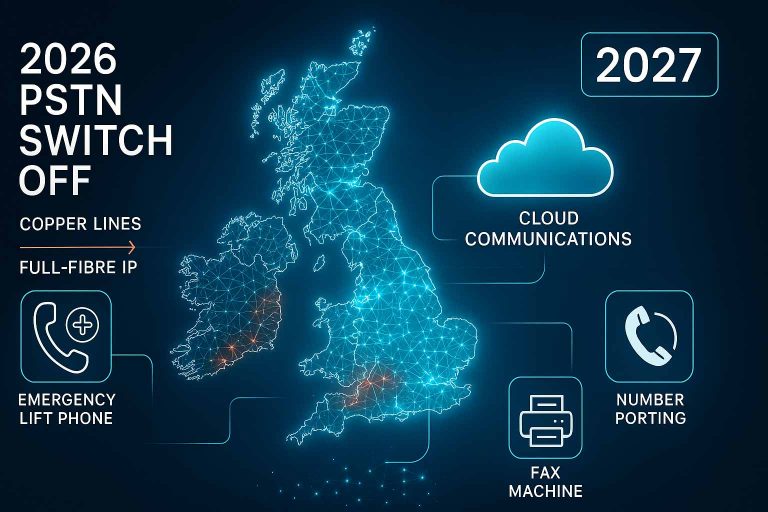
The PSTN switch-off doesn’t just affect your desk phones. It impacts everything that “dials out” over a copper wire:
- Alarms: Legacy intruder/fire diallers may fail to signal monitoring stations.
- Lifts: Emergency lift phones are often the most overlooked PSTN dependencies.
- Payments: Older PDQ machines require an analogue handshake that doesn’t exist on digital lines.
Expert Insight: The Unified Communications Pivot
“The transition from PSTN isn’t just a technical swap; it’s a fundamental change in how your business presents itself. Moving to SIP or Hosted allows you to break free from local area codes. You can have a London number while your team is based in Manchester, and you can reroute calls with a single click in an emergency. The flexibility alone usually pays for the migration within 12 months.” — Talking VoIP Technical Strategy Team
The Cost of Delay: Why 2027 is the Hard Limit
Waiting until late 2026 to migrate is a high-risk strategy. As the deadline approaches, we anticipate three major bottlenecks:
- Porting Backlogs: Number porting currently takes 10–15 days. Expect this to spike to 60+ days as the national rush begins.
- Hardware Shortages: Global supply chains for IP-handsets and routers will be under immense pressure.
- Labour Shortages: Lead times for on-site engineer assistance will skyrocket.