
What the PSTN/ISDN Switch Off Actually Means for Your Business
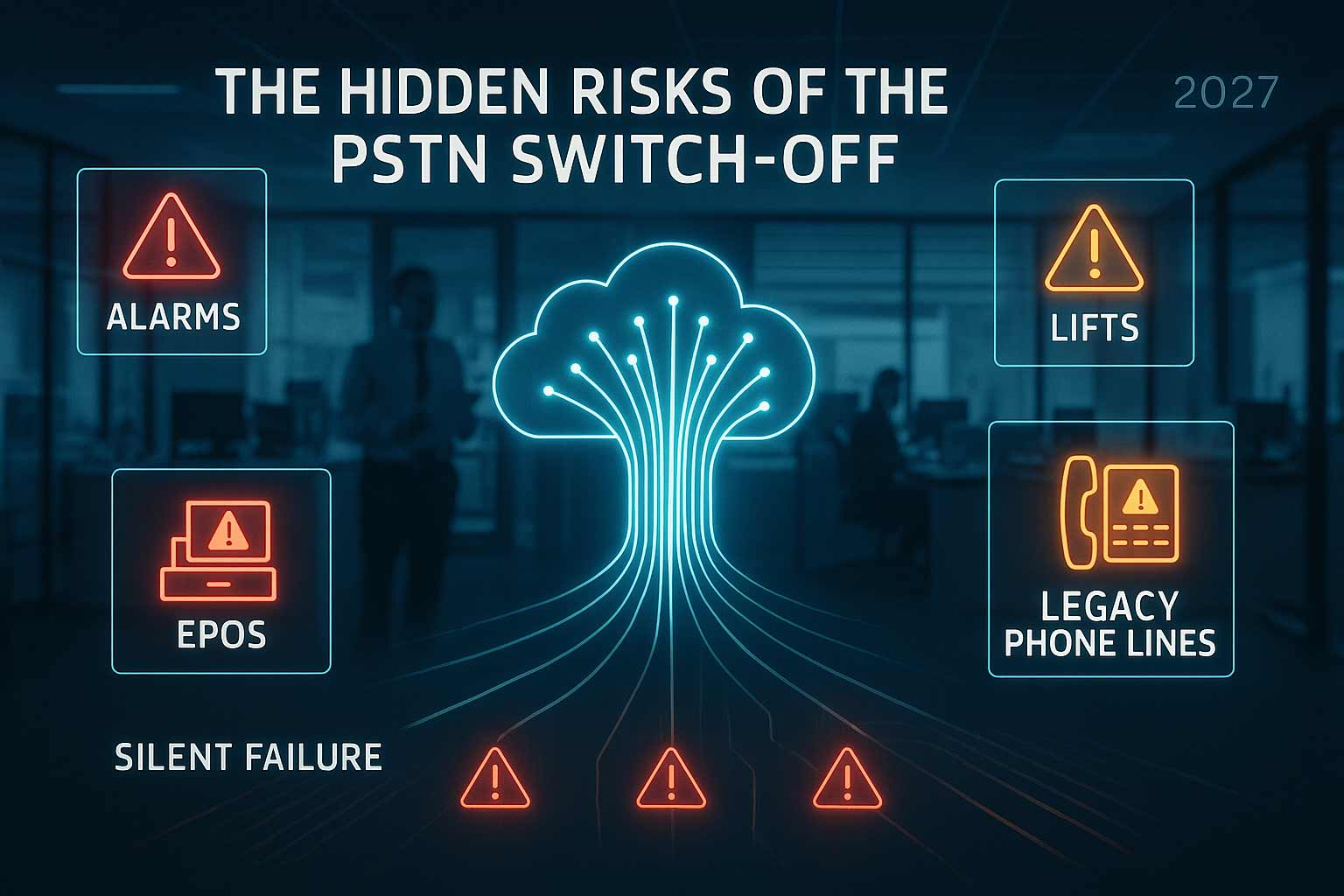
The greatest risk of the PSTN switch-off isn’t a silent phone—it’s the “Silent Failure.” Many legacy devices connected to the copper network do not “send a heartbeat.” This means you won’t know they have failed until you try to use them in an emergency. With the 2027 deadline approaching, UK businesses must audit for hidden vulnerabilities like alarms, lifts, and EPOS systems that are hardwired to the past.
CTA: Request a Free Infrastructure Audit → https://talkingvoip.co.uk/contact/
The 2027 Deadline: Beyond the Telephone Handset
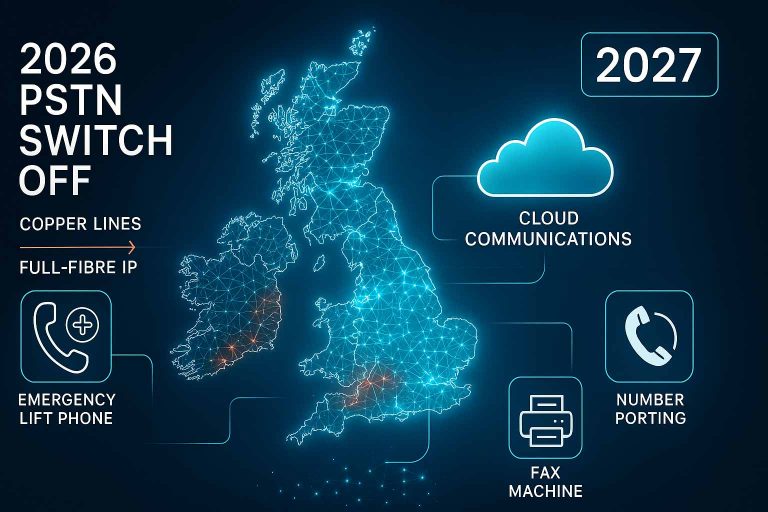
For over a century, the Public Switched Telephone Network (PSTN) has been the bedrock of British communication. It is a system built on physical copper wires, mechanical exchanges, and an ageing infrastructure that is now reaching its end-of-life. Openreach has officially confirmed that by January 31, 2027, the PSTN and ISDN networks will be fully retired.
For an IT Manager or Operations Lead, the switch-off is often framed as a “phone system upgrade.” This framing is dangerously narrow. The switch-off is actually an infrastructure overhaul. Any device in your building that plugs into a standard telephone wall socket (typically the Master Socket 5C or older) is at risk of immediate failure as the exchange is deactivated.
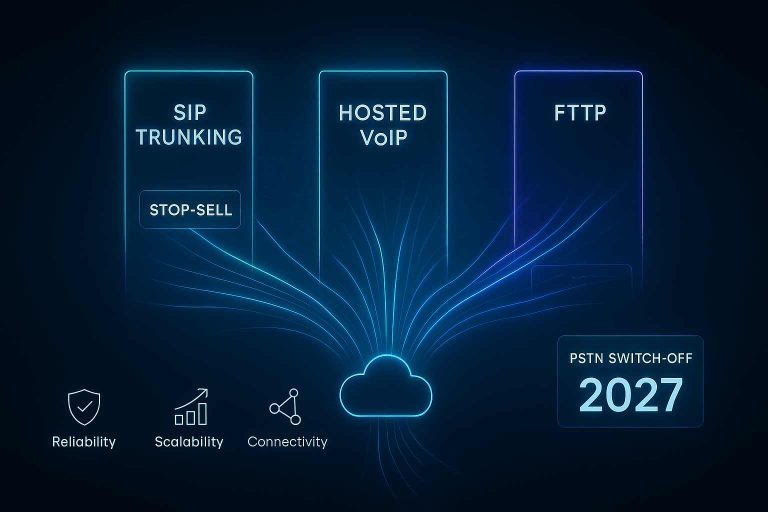
In 2026, we are already seeing “Stop-Sell” orders across the UK. This means you can no longer purchase new analogue lines or modify existing ones. If your business moves premises or needs to scale, you are already living in an “All-IP” world, regardless of the 2027 final deadline.
The “Silent Failure” Concept: A Critical Warning
The term “Silent Failure” describes a scenario where a device appears operational on the surface but has lost its ability to communicate externally. Because PSTN technology is unidirectional for many monitoring services, the local hardware may not trigger an error light when the line goes dead. You only discover the failure when the device is needed most.
The Critical Hit List
While phones are obvious, these three areas are the most common sources of silent failures:
1. Security & Fire Alarms (Redcare)
Legacy intruder and fire alarms often use “Redcare” signalling. These systems rely on the low-voltage current provided by the PSTN copper line. When the network is switched off, the monitoring station will simply stop receiving signals. Without a transition to IP-signalling or 4G-monitored dual-path systems, your building is unprotected and your insurance may be voided.
2. Passenger Lift Emergency Phones
Under BS EN 81-28, lift owners are legally required to provide a functional two-way communication system for trapped passengers. Historically, these have been PSTN-based. A dead line in a lift isn’t just a technical glitch; it’s a massive health and safety liability that can lead to the immediate closure of your facility by inspectors.
3. Payment Terminals & EPOS
Do you have a basement retail space or a thick-walled warehouse where Wi-Fi is spotty? Many legacy PDQ machines use “dial-up” functionality as a fallback or primary connection. Once the PSTN is retired, these machines will fail to authorise payments, leading to lost revenue and customer frustration.
Infrastructure Risk Matrix
| Device Type | Legacy Connection | Digital Alternative | Risk Level |
|---|---|---|---|
| Passenger Lifts | Analogue PSTN | GSM / VoIP Gateway | CRITICAL |
| Fire Alarms | Redcare / DualCom | IP / 4G Monitoring | CRITICAL |
| Security Cameras | Analogue DVR | Cloud-Based NVR | HIGH |
| Intercoms | Analogue Phone Line | SIP Intercom / Hosted | MEDIUM |
The Power Resilience Gap: Why VoIP is Different
One of the most overlooked aspects of the All-IP transition is power. Legacy copper lines were “self-powered” from the exchange. You could plug a basic phone into a wall socket during a complete local blackout and still dial 999. This is because the telephone exchange provided roughly 50V of DC power directly through the wire.
Digital lines (VoIP) do not carry electricity. They are purely data streams. If your building loses power, your internet router turns off. If your router turns off, your entire phone system—including emergency lines—goes dead instantly.
Operational Tip: The Battery Backup Requirement
Every business migrating to a Hosted VoIP solution should implement a UPS (Uninterruptible Power Supply) for their core networking equipment. At a minimum, your router and your primary PoE (Power over Ethernet) switches must be backed up to ensure at least 60 minutes of uptime during a power failure. This is not just a recommendation; for businesses with on-site staff or residents, it is a safety essential.
Proprietary Insight: The TalkingVoIP Migration Risk Index (MRI)
Before you commit to a new contract, use our proprietary MRI framework to score your current readiness. Answer the following questions honestly:
1. Inventory Audit (25 Points): Have you physically traced every wire coming out of your Master Phone Socket? If you haven’t identified every “hidden” device like franking machines or telemetry sensors, score 0.
2. Vendor Compliance (25 Points): Do you have written confirmation from your Alarm and Lift maintainers that your current hardware is IP-compatible? If not, score 0.
3. Connectivity Quality (25 Points): Are you currently using Full Fibre (FTTP) or SoGEA? If you are still on ADSL or FTTC with a phone line, score 0.
4. Power Continuity (25 Points): Do you have a tested UPS system on your server rack? If not, score 0.
Target Score: 100 | Most UK SME Businesses score: 25
Common Mistake: Relying on ATA Adaptors
An Analogue Telephone Adaptor (ATA) is a small device that allows you to plug an old analogue phone into a digital internet connection. While these are useful for basic voice calls, they are often used as a “lazy fix” for complex systems.
The Risk: Many ATAs struggle with the “Handshaking” protocols required by older modems, fax machines, and security panels. Relying on an ATA for a life-safety device (like a lift phone) is risky and often results in dropped packets that prevent the call from completing. A native IP solution or a dedicated GSM gateway is always the superior choice for business continuity.
Next Steps for UK Operations Leads
The transition to All-IP is not something that should be handled as a “Friday afternoon task.” It requires a staged approach to ensure that your business remains operational and compliant.
- Phase 1: The Site Audit. Identify every single PSTN/ISDN line. Check your billing for “Analogue Line Rental” charges.
- Phase 2: Broadband Transition. Upgrade your connectivity to a data-only line (SoGEA or FTTP). This severs the link between your internet and your phone line.
- Phase 3: Hosted Migration. Move your voice services to a Hosted VoIP platform. This allows you to retain your existing numbers while gaining features like Teams integration and mobile apps.
- Phase 4: Life-Safety Upgrades. Work with your specialist contractors to install IP or 4G signalling for alarms and lifts.