
PSTN Switch Off FAQ: The Ultimate Business Troubleshooting Guide
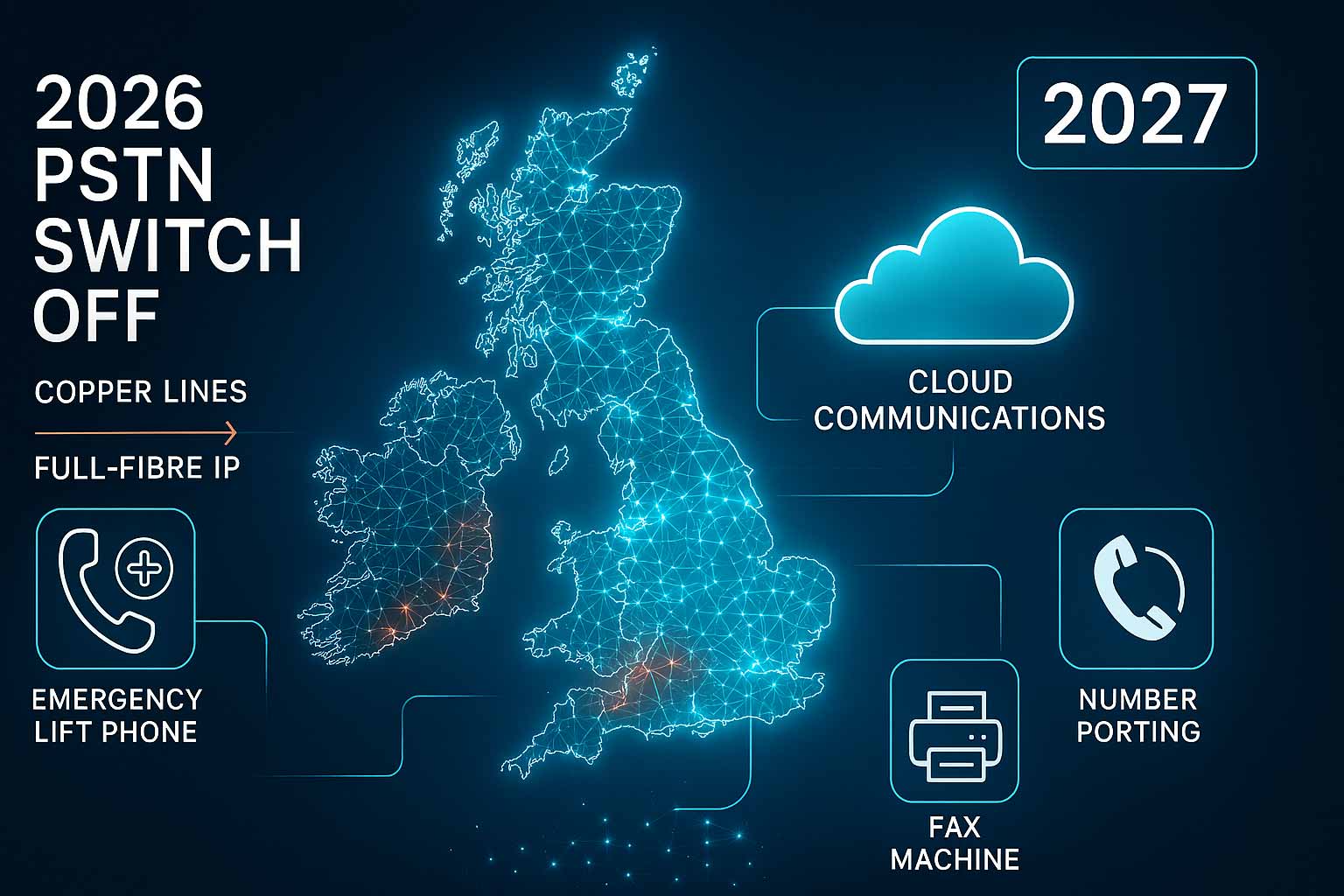
As we move through 2026, the “All-IP” migration is no longer a future project—it is a live operational hurdle. With the January 31, 2027 final deadline fast approaching, businesses are discovering that the PSTN switch-off is about much more than just desk phones.
From emergency lift autodiallers to mission-critical security alarms, the legacy copper network supports a vast ecosystem of hardware that simply isn’t designed for a digital world. This FAQ is your technical roadmap, answering the “hidden” questions that standard VoIP providers often overlook.
1. The Emergency Lift Phone: Safety & Compliance
Q: Why will my lift phone stop working?
Traditional lift emergency phones (autodiallers) rely on a “voltage-driven” copper line. They draw power and a dial tone directly from the exchange. Digital VoIP lines do not provide this same electrical current. Furthermore, VoIP compression can “clip” the DTMF tones that lift monitoring centres use to identify which building is calling.
Q: What is a GSM Gateway, and why do I need one?
A GSM Gateway is the industry-standard replacement for a PSTN lift line. It is a small device that houses a roaming SIM card (connecting to the strongest available UK network).
- The Benefit: It operates independently of the building’s internet and power.
- Compliance: To meet EN 81-28 safety standards, your gateway must include a battery backup that lasts at least one hour in a power cut.
Q: Can I just plug the lift into my new VoIP router?
We strongly advise against this. If your building loses power, your internet router dies, and the lift phone dies with it—exactly when a trapped passenger needs it most. A GSM Gateway is the only way to ensure 99.99% “Life Safety” resilience.
2. Alarms, Fire Panels & Security Signalling
Q: My alarm uses “Redcare” or “Digital Communicator.” Is it safe?
BT Redcare is being officially retired (August 2025/2026). If your alarm system relies on a physical copper “path” to signal the Monitoring Station (ARC), it will cease to function. You need to upgrade to a Dual-Path IP/GSM Communicator (e.g., CSL DualCom) which uses internet as Path 1 and a 4G SIM as Path 2 backup.
Q: Will my fire alarm be affected?
Yes. Many fire panels use “PSTN Diallers.” These often fail on digital lines because the modem “handshake” protocol is distorted by digital conversion. Check with your fire safety officer immediately to avoid breaching insurance requirements.
3. Fax Machines & Legacy Hardware
Q: Will my fax machine work on a VoIP line?
Technically, you can use an ATA (Analogue Telephone Adapter), but faxes often fail mid-transmission on digital lines. Pro Recommendation: Move to a Fax-to-Email service. It is more secure, cheaper, and 100% reliable.
Q: What about my franking machine or card terminal?
Most modern units have Ethernet ports. If yours still plugs into a phone socket, it is legacy. Contact your provider for an “IP-enabled” model before your local exchange hits its “Stop-Sell” date.
4. Number Porting & Business Continuity
Q: Can I keep my existing business number?
Yes. Through “Porting,” we move your number to the cloud. It is then no longer tied to a physical wire. You can answer your 01494 (or any local) number on desk phones, laptops, or mobile apps globally.
Q: How long does the porting process take?
A “Simple Port” takes 7–10 working days. “Complex Ports” (multi-line DDI ranges) can take 20+ days. Golden Rule: Never cancel your old contract until Talking VoIP confirms the port is verified, or you may lose the number forever.
5. The 2027 Countdown: Why Now?
Openreach extended the final deadline to January 31, 2027, but the “Stop-Sell” is active now. If you do nothing, your dial tone will vanish on your exchange’s switch-off date. Recovering service after a forced disconnection is significantly more expensive than a proactive migration.
| Feature | Legacy PSTN | Digital (VoIP) |
|---|---|---|
| Power Source | Exchange Powered | Local Power Required |
| Call Quality | Standard (G.711) | HD Voice (G.722) |
| Flexibility | Fixed to Wall Socket | Geo-Independent |
| Safety Devices | Native Support | Requires GSM Gateway |
Expert Insight: The “Invisible” Risk
“The biggest mistake we see in 2026 is businesses assuming their ‘Full Fibre’ broadband means their phone system is already digital. If you have a physical phone socket on the wall that doesn’t plug into your router, you are still at risk.” — Talking VoIP Technical Lead