
SIP Trunking: The Direct PSTN Replacement for Multi-Site Operations
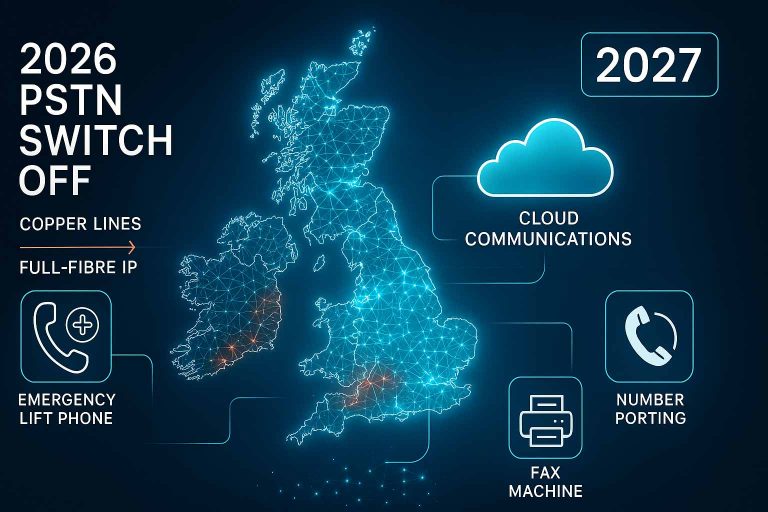
The UK’s PSTN and ISDN network is being permanently retired by 2027. For multi-site organisations with significant hardware investment, SIP Trunking offers a high-performance, cost-effective bridge to modern digital telephony without the need for a full system overhaul. Secure your business infrastructure against the 2027 “copper sunset” while reducing overheads through strategic line pooling.
CTA: Speak to a multi-site SIP specialist → https://talkingvoip.co.uk/contact/
What is SIP Trunking in a Post-PSTN Landscape?
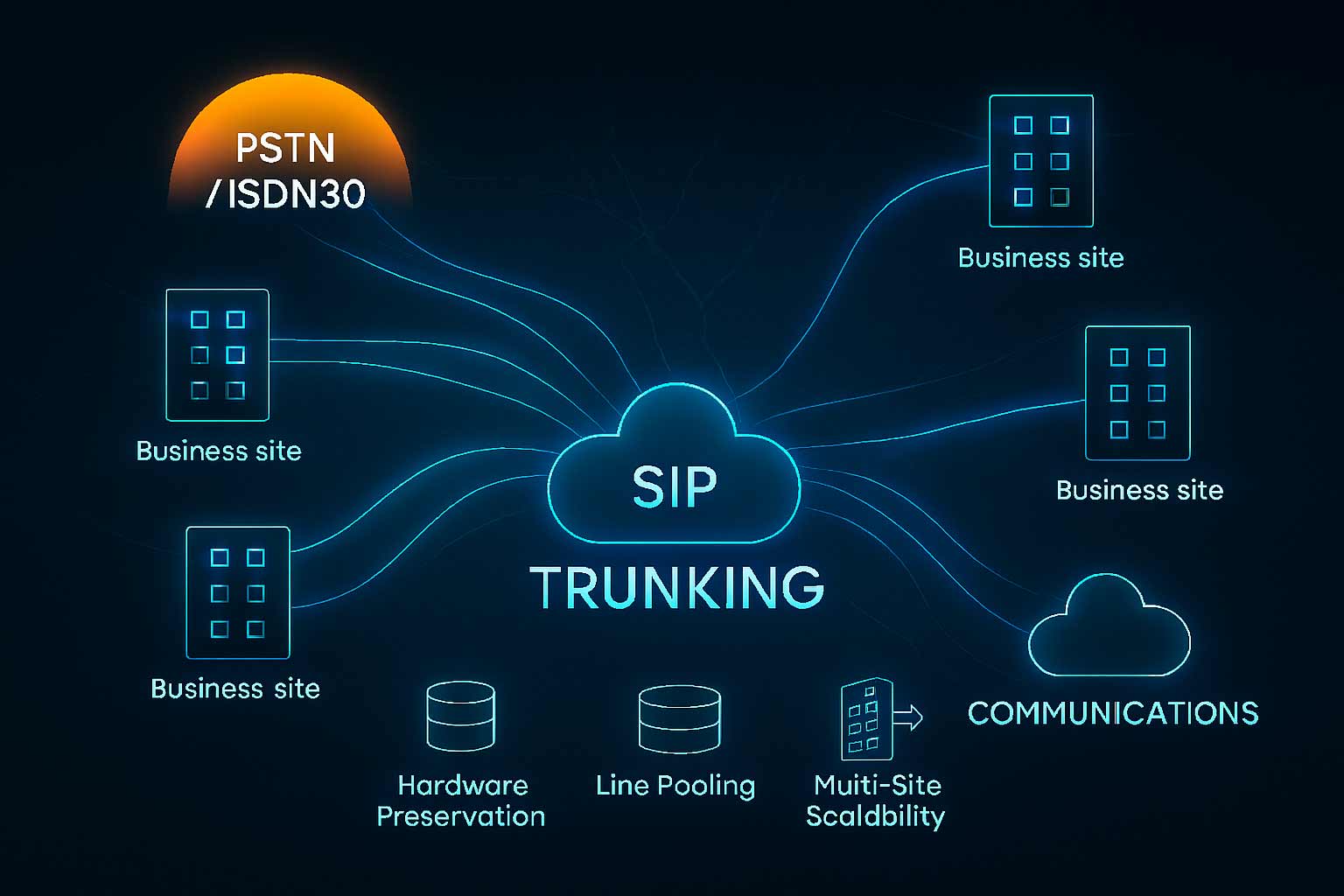
SIP Trunking (Session Initiation Protocol) is the digital equivalent of a traditional phone line. Instead of physical copper wires or ISDN30 pipes entering your building, SIP uses your internet connection to carry voice traffic. For businesses operating across multiple locations, it serves as the ultimate consolidation tool, replacing disparate legacy connections with a unified virtual stream.
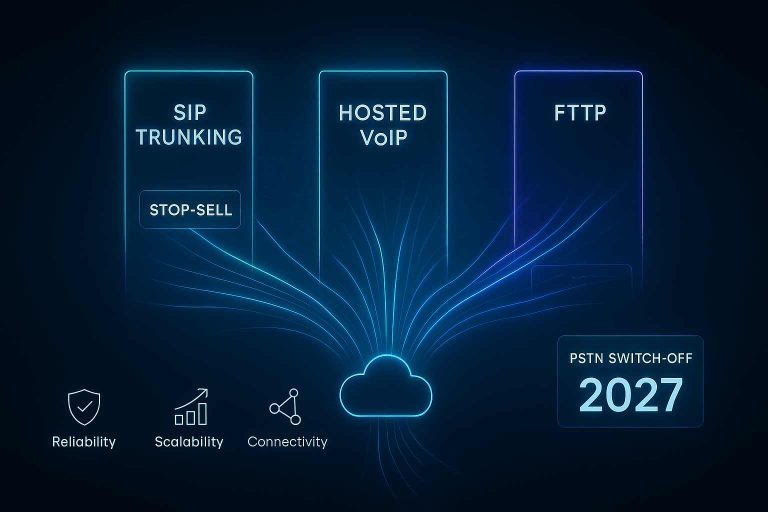
As the 2027 Stop-Sell fast approaches, SIP Trunking has emerged as the primary “lift and shift” solution. It allows IT Managers to maintain their existing On-Premise PBX (Private Branch Exchange) while upgrading the underlying connectivity. This approach avoids the massive capital expenditure (CapEx) associated with replacing handsets and servers at every branch simultaneously.
The Value of SIP for Multi-Site Estates
For an Operations Lead managing ten, twenty, or fifty sites, the complexity of the PSTN switch-off is significant. SIP Trunking simplifies this by centralising your voice traffic. Rather than managing 50 separate contracts with 50 separate billing dates for various local lines, you move to a single, scalable SIP provider. This provides a “single pane of glass” view of your entire UK communications infrastructure.
Investment Protection for Existing PBX
If your organisation has invested heavily in an on-premise PBX (such as a 3CX system, Mitel, or Avaya), “ripping and replacing” that hardware is rarely the most efficient path. SIP Trunking allows you to keep your current hardware. By using a VoIP Gateway or a simple configuration change, your existing PBX can talk to the Talking VoIP network, instantly modernising your capabilities while sweating your current assets.
Strategic Line Pooling vs. Site Silos
In the legacy world, a business with 10 offices might have 10 separate ISDN2 or ISDN30 circuits. If Site A was quiet and Site B was overwhelmed with calls, Site B would experience busy signals despite Site A having idle capacity. This inefficiency is a silent drain on UK business productivity.
SIP Trunking introduces Line Pooling. This allows you to purchase a single “pool” of channels (e.g., 100 channels) that are shared dynamically across all sites. If one branch has a seasonal surge in calls, it can draw from the central pool. This eliminates the waste of paying for “idle” lines at quiet branches, often reducing monthly line rental costs by 40% to 60%.
Technical Comparison: SIP vs. Legacy ISDN30
| Feature | Legacy ISDN30 / PSTN | Talking VoIP SIP Trunking |
|---|---|---|
| Connection Type | Physical Copper/Fibre | Virtual (Over Ethernet) |
| Scalability | Slow (Weeks for install) | Instant (Digital provision) |
| Disaster Recovery | Fixed to physical site | Advanced Dynamic Rerouting |
| Cost Model | High Fixed Rental | Low Rental + Pooled Channels |
| 2027 Status | NON-COMPLIANT | FULLY READY |
Expert Insight: The Myth of the “Local” Number
“One of the biggest misconceptions we encounter in multi-site migrations is that numbers are still ‘tied’ to a physical exchange building. With SIP Trunking, your Manchester office can project a London presence, or your Scottish support centre can answer calls for a Bristol branch seamlessly. Geography is no longer a constraint; it is now a choice.” — Talking VoIP Technical Team
Advanced Resilience and Disaster Recovery
Unlike traditional copper-based lines, SIP is not tied to a physical street address. If a local exchange fails or a construction crew cuts a cable outside your office, traditional lines go dead. Recovery often takes days as engineers must physically repair the link.
With SIP Trunking, resilience is baked into the architecture. We can configure automatic failover triggers to ensure your business never misses a customer touchpoint:
- Primary Route: Your main office PBX over high-speed fibre.
- Secondary Route: A secondary branch or disaster recovery site via an encrypted tunnel.
- Tertiary Route: Instant rerouting to the Talking VoIP mobile application or an automated IVR.
The Talking VoIP Migration Risk Index (MRI)
Use this proprietary framework to assess which of your sites are most “at risk” as we approach 2027.
Level 1 (Low Risk): Site already uses a modern IP-PBX and has a reliable fibre connection. Action: Simple SIP migration.
Level 2 (Medium Risk): Site uses an older PBX but has an ISDN-to-SIP gateway. Action: Audit hardware firmware for SIP compatibility.
Level 3 (High Risk): Site relies on analogue PSTN lines for alarms, lifts, or fax. Action: Immediate requirement for ATA adapters or full SIP replacement.
Level 4 (Critical): Site is in a “Stop-Sell” zone with no upgrade path planned. Action: Urgent priority migration to avoid service loss.
Operational Tip: Auditing Your Multi-Site Bandwidth
Before deploying SIP, ensure your data connection is “Voice Ready.” A single G.711 voice call requires approximately 100kbps of synchronous bandwidth. For a site expecting 20 concurrent calls, you need at least 2Mbps of dedicated headroom. We always recommend a managed Leased Line or a SoGEA connection with prioritized Quality of Service (QoS).
Step-by-Step: How to Replace ISDN with SIP
- Site Audit: Identify every ISDN30, ISDN2, and PSTN line. Don’t forget “hidden” lines for franking machines.
- Number Porting: Submit a request to move existing numbers to the Talking VoIP network (allow 10-20 days).
- Connectivity Check: Ensure each site has a SoGEA or Full Fibre connection with QoS enabled.
- Gateway Configuration: Install a Gateway for older PBXs or input SIP credentials into modern systems (like 3CX).
- Pilot Test: Migrate a single non-critical site first to verify call quality and latency.
- Full Migration: Execute a phased cutover, scheduled out-of-hours to ensure zero downtime.